Thursday, June 20, 2013

Con perros y gatos

I am trying my hand at writing in Spanish. This article is about the state of domestic animals and strays in the city where I currently live, Morelia, Michoacan. As always, leave a comment, I love to know what you think!

¿Alguna vez has visto un animal lastimado o atropellado en la calle? Circulando por las calles de cualquier ciudad es probable que tarde o temprano, encontrarás un animal doméstico, ya que sea perro o gato, herido. La ciudad de Morelia no es diferente. Hace poco en Morelia, vi un gato atropellado en la calle. A primera vista pensé que ya estaba muerto, pero a pasar a un lado del animal, vi que movía su cola. “Pobre gato” pensé, y sentí una gran tristeza por ese ser que obviamente estaba sufriendo. Sin embargo, seguí mi camino salvo que llegara tarde a la cita que tenía. Reconozco que esta actitud de indiferencia es muy común. Como sociedad hemos acostumbrado a “esto no es mi problema” cuando en realidad la situación con animales compete a todos. Quizas diras “pero tienen dueños y ellos son los que tienen que cuidar a sus mascotas” sin embargo, en la actualidad solamente 1 en cada 10 animales en situación de calle son reclamados por sus dueños. Como bien lo comentaron Marielena Hoyo,  ex-directora del zoológico de Chapultepec, Tania Muller, secretaria del medio ambiente del Distrito Federal y Georgina Molina, presidente de la asociación Rescate Animal el mes de abril pasado en CNN, México Opina (dale clic aqui para ver el video) hay una gran problema con el maltrato animal en las ciudades de México.
fuente:www.ghapad.com
Los refugios para animales en la ciudad de Morelia son varios, como Perra Vida, Adopta Amor, Hogar Refugio Lumi, Amar y Ghapad. En Morelia Ghapad tiene más de 10 años operando, rescatando animales y abogando por la concientización de la sociedad acerca de la condición de los animales. También cuenta con refugios en Tacambaro, Lázaro Cárdenas y Tarimbaro.  El refugio Ghapad trabaja no solamente con los animales sino también con las personas ya que la educación es una parte integral del cambio de cómo son tratados los animales. Tuve la oportunidad de conocer a dos personas entregados a trabajar con los animales. Fernando Valladiva, voluntario del Ghapad  y Carlos Herredia Gonzalez.
A Fernando Valladiva le hice la pregunta ¿qué deberíamos hacer, los ciudadanos urbanos, cuando nos encontramos a animales en situaciones donde han sido heridos o atropellados?
“Yo aconsejo que llevar en el carro una toalla o manta y un botiquín de primero auxilios” comenta Fernando, y agrega “al momento de acercarse al animal, ponte entre la calle y el animal. No dejes que el animal te vea ya que se podría espantarse. Toma el animal desde atrás y en el caso de un perro, cubre su boca y cargo el animal con cuidado. Hay varios medicos veterinarios en la ciudad de Morelia quienes trabajan con animales rescatados, entre ellos están es el doctor Hugo Valiente.”
fuente:Cambio de Michoacan
Fernando está muy ocupado, es el paseo dominical de los perros del refugio, y se va con una perrita que parece French Poodle, llamada Candy. Espero a Carlos Herredia Gonzalez, voluntario fundador de Ghapad. Nos sentamos debajo de un árbol ya que es un día muy caluroso y el sol esta fuerte. Carlos saca un cigarro  y me ofrece uno. Le agradezco pero no fumo. Nos ponemos a charlar mientras Carlos fuma su cigarro. Comienza a explicar acerca de la situación actual de los animales domesticados en México. “”Existe una laguna legal impresionante.” Pregunto acerca de un caso reciente en las redes sociales donde se dio a conocer que un caballo había sido atropellado en la glorieta de Juan Pablo II en Altozano. “En este caso del caballo llamaron al zoológico pero esto no esta en su competencia a nadie le compete a través de asociaciones varios frentes existe una responsabilidad ciudadano. Animales de trabajo son registrados con dueño.”
Carlos termina su cigarro y le hago la siguiente pregunta, ¿cómo podemos generar un cambio en la sociedad ante como son tratados los animales? La respuesta de Carlos es conciso y apasionado. “Recoger perros y gatos no ayuda a nada, no soluciona el problema...va en aumento. El problema viene de la gente y por una [falta de] respeto a la vida. [Hemos tenido un] acercamiento al ayuntamiento para cambiar leyes y reglamentos, formar y generar cultura, propuestas de ley aunque ya existe una ley desde 1988 con Villicaña. En papel esta bien pero no hay quien lo aplique.”
Carlos se ve interrumpido cuando uno de los perros que esta siendo paseado por uno de los voluntarios empieza a ladrar a otro perro y tumba a su paseador. Carlos se pone de pie rápidamente y corre al auxilio del hombre.
Regresando a la sombra del árbol donde iniciamos nuestra charla, Carlos me sigue contando de actual situación de la ley para la protección de animales en Michoacan. “[Hubo una] ley propuesta del PAN en Michoacán...del refugio fueron a pedir apoyo Macarena Chávez y Dr Morelos bloquearon la ley por los toros, mostraron su falta de conocimiento en la ley propuesta”.  Carlos explica “volvieron hacer la ley por el Partido Verde muy parecido lo que habían ya trabajado. Ahora la ley del medio ambiente y la sigue es de protección animal.”
Y finalmente cuando le cuento del gato que había visto atropellado en la calle, Carlos me comenta que pudiera haber llamado a la perrera y quedarme a acompañarlo en su proceso de muerte “hasta donde tu te puedes comprometerte con ese animal.” El sol ya esta muy fuerte y aún hay más perros por pasear. Carlos se pone de pie y me dice “esto no lo hacemos por los perros,  lo hacemos por nosotros porque queremos vivir en una sociedad mejor.”

Para más información acerca de Ghapad, consulta su página de Facebook. Ahi encontraras informacion acerca de veterinarios quienes colaboran con el refugio y también todo tipo de información de como ayudar a animales en situaciones de peligro.

Monday, June 10, 2013

Temazcal Part 2

This is part two of my article describing my recent visit to a local temazcal. For part one, click here. To watch two short videos explaining what a temazcal is click here. If you are interested in re-printing this article, please leave me a comment or email dushka.rinasz(at)gmail.com


Sweating it Out in a Temazcal

by Alma Maria Rinasz


My intentions. Earlier I had told myself I wanted balance. As any mother knows and is told by numerous mommy blogs and parenting websites, I needed “me” time. I had recently stopped breastfeeding, my role as the caregiver of an infant, that final extension of pregnancy that breastfeeding creates, was now over. Our baby was becoming a toddler and I longed for a space where I could once again find myself, not in terms of this child’s mother, but in terms of who I am as an individual. There were also other factors that brought me to the temazcal, namely feelings left over from relationships that I needed to let go of, chronic sinusitis and the curiosity of actually partaking in a temazcal. I needed to figure out how to balance everything. I was there because I needed a space for healing my physical body and my emotional self.
It is now my turn to enter. “I am here to heal my body and my soul” I said softly as Carmen looked up at me from the temazcal doorway. Crouching down, asking for permission from the guardians, I half walk, half crawl into the temazcal and feel the impact of the dry 50 degree celsius heat. Carmen asks us not to walk over the center of the round temazcal. Later she explains that this is one of the four doors of the temazcal. With everyone inside, the door is closed from the outside. I make the mistake of entering wearing my glasses. I have myopic vision and an acute astigmatism. I quickly realize that I need to leave the glasses outside.  Carmen continues with the ritual, she passes a small deer skin drum with its accompanying stick, a maraca, a box of kleenex.  The musical instruments are for us to use when chanting if we want. The kleenex for cleaning our noses (she explains that people tend to get runny noses inside because of the steam).  Carmen explains that we must honor the four directions as a part of the ritual. After the fourth direction is honored, the temazcal will be over. She points out that there are four “doors” in the temazcal that correspond to the directions. We must ask the divine guardians permission to speak before we speak, if we must exit we must ask permission to do so and the same if we wish to re-enter.
I am surprised how quickly the intensity of the heat gets to me. Suddenly I vividly recall how I felt when I was in labor with our third child, the baby that has just left his mother’s milk. Just as in labor, the experience at that moment brought me entirely into the now. I was extremely present, there was nothing before this time and there is nothing to come: there is only now and the intense weight of the heat. Carmen explains that we can drink herbal tea out of a communal cup, asking us to only wet out mouths and throat. She then offers us aromatic branches to move the air above our heads or to softly beat against our legs (to help circulation). We can also sprinkle clear, clean water on our skin. Carmen uses a specially prepared mixture of water and herbs to douse on the fiery volcanic rocks that produce the intense heat.  With each wetting of the rocks, Carmen honors one of the four directions/doors of the temazcal.  After honoring the first door, she tells us to lay down if we feel the need. I  awkwardly lay down on the wooden floor. It smells like a sauna, the smell is comforting and clean. I can feel my fellow temazcal bathers push up against me. This must be what multiple babies in one womb feel like. My legs are awkwardly positioned on the temazcal wall, I am turned at the waist, laying face down on the temazcal floor. Just as in labor, I suddenly feel the urge to vomit. I begin to panic: I can’t vomit here! I take in a deep breath.
Carmen as if she had read my mind, distracts me by telling us that if we feel the need to leave, we can get closer to the door to feel the breeze.  She urges us not to leave. I drag my face and torso closer to the door, as do seven other people. The urge to vomit begins to subside. We are all so close to one another, I can feel someone holding my arm. My glasses had already been placed outside the door, so it is impossible for me to see who is holding me. My husband, sitting next to my legs, pulls at my sheet, covering up my inner thighs. My attention is brought back to the door, we are waiting for some cool air. Except that the “hobbit house door” is not letting any cool air sweep our sweaty bodies. One of the other temazcal users, the only other man besides my husband, sticks out his hand and says “ask the Lord for the breeze, he will send it to us”. Oddly enough, hearing this petition, is when I find it difficult to want to stay. I snicker and silently guffaw. But then I catch myself in my own hypocrisy: if I am willing to ask a deity permission to enter this sweltering igloo, why not ask some other deity for some wind? A soft breeze comes in and we sigh.
I speak up and tell my fellow temazcal brothers and sisters that I feel like I am in labor again. Carmen guides us through chanting, at times we moan, at we are times silent, other times some of us cry. She explains that we can call out our own names, she leads us in the example and we all call out her name “Caaar-meeen” we yell loudly. The noise we make is sad and full of longing, my voice cracks and I sob a little. We are crammed into a temazcal, a steam bath used for traditional healing practices dating from pre-hispanic times. We are united in our self-induced discomfort. Carmen had told us prior to entering that she had been using the temazcal for over twenty years.  Later, in our interview she tells me that she has been guiding people in her own temazcal for two years. “There are times when people enter the temazcal and they want to leave right away. This has to do with their mental and emotional preparation.”  
Looking back, I can say with certainty that being in such a small space, dark and hot, was comforting and terrifying. It makes me think of what it is like to be a fetus. It makes me think of things that I can’t possibly remember or even know for sure; I can only feel them on an intuitive level. One of the uses of the temazcal is psychotherapeutic. Carl Jung spoke of the shadow or unconscious.  In Macina’s words “the temazcal is a representation of the interior of the Earth, it is a cave. Like the clefts of the Earth-gullies, holes, caves-it puts the surface world in communication with the subterranean world.” Carmen has guided us through those dark recesses of our minds and souls. I also later find out that she is a psychotherapist, I believe this makes her an even better guide.
Unbeknownst to me, as I am panting and living the now of the temazcal, Carmen is honoring the fourth door. The temazcal is over. I suddenly feel as if I could stay in there for hours. My fellow temazcal bathers begin to exit. I say behind, helping Carmen clean out the temazcal. I hand her the branches, the drum, the maraca, the water: I don’t want to leave. Again I am reminded of a baby, those stubborn children that don’t want to be born, they stay in until their moms are 41 or 42 weeks pregnant. I don’t want to leave the inside where it is warm and wet and dark. I like it here. Carmen smiles at me and I look around one more time, my blurry vision only allows me to see so much, a play between light and shadow, but I smell eucalyptus and rue. I will come back I tell myself and emerge into the light.
I am doused with cold water and asked to remove my sheet as Carmen’s daughter wraps me in a clean towel I have brought from home. I stop her mid wrap. I have to pee and Carmen asks me if I am comfortable peeing outside. I answer “I was a girl scout, I can pee anywhere” and I run behind the dome of the temazcal to relieve my bladder. I shake and tremble and I feel so alive. I return and am duly wrapped up in a cocoon of soft warmth and I lay on the wooden deck where I see that Alex is already snoring. The temazcal ends in us eating oranges and bananas and drinking cold rose hip tea. We then go off to eat a light dinner which is followed by a guided meditation lead by our yoga teacher from earlier that day.

Coming into the light
There is a term in Spanish for giving birth. It is called dando a luz or bringing into the light. The temazcal has been used for centuries as a way to prepare women for childbirth. Vicenza Lillo Macina explains that the objective was to “relax [women’s] muscles, nerves and joints” The midwife, or partera, uses different treatments, “she´ll massage the parturient woman’s abdomen...and she will straighten the offspring incase it is feet first. After birth, the mother will receive various very hot baths so she can recover the heat she has lost after birth and so that the cold that [she feels] goes away.”
Carmen Magallon explains that women, in ancient times, used to give birth in the temazcal. One of the practices often employed by midwives when a woman is having trouble transitioning into the third phase of labor is to reduce the light. A dark or soft lighted space is believed to help women deliver their babies with more ease and comfort. A temazcal, recreates the in vitro environment: it is dark and warm. I can see why ancient parteras or midwives, used the temazcal for birthing. It seems fitting that temazcal ritual included asking permission of the mother of the gods. “I used it after my daughter was born” Carmen explains “and I took her in when she was 40 days old”.
“Women would have their children in the temazcal. Also, after giving birth, after the first forty days women would enter the temazcal. Now a days that is the aspect of the temazacal that has been preserved; the use by women. Why? I think mainly because of the use of the parteras (midwives) it is rare that women have babies in the temazcal now, that is something that was done before, within  the groups of First Nation people. One thing that is done now it that in lieu of an actual traditional temazcal, women in some communities recreate the temazcal using blankets.
From my own personal experience, “discovering” the temazcal has given me an opportunity to take an active role in my own physical and emotional health. The combination of plants, herbs and Aromatherapy has been studied somewhat by Western medicine. Empirically, I find that inhaling eucalyptus opens up my breathing passages, rubbing mint oil on my tired legs and feet invigorates and refresh me and I don’t need a medical study to tell me that that  works for me. I’ve found that Western medicine more than often loses sight of the patient as a person, you are a post nasal drip, type II hemorrhoids, type III diabetes, a malignant tumor. Traditional medicine tends to deal with the patient as a whole. The body, soul, spirit are all honored in traditional medicine.  Western medicine is just “discovering” what traditional medical practitioners have known for thousands of years: emotions and thoughts directly influence our physical health. My symbolic rebirth, coming out of the temazcal, into the light of day, gave me a sense of balance. My objective, my intention was fulfilled.
-Alma Maria Rinasz
For more information on the temazcal, please read Vicenza Lillo Macina’s book
If you are in the Morelia area and would like to experience the temazcal first hand, please visit Cerro Verde Facebook page https://es-la.facebook.com/temazcal.cerroverde

I strongly suggest that if you partake in a temazcal you first ask what the practice is during the temazcal, if the guide is particularly strict about you being able to leave the temazcal before the ritual is concluded you may find your experience causes suffering instead of healing.

Wednesday, June 5, 2013

Temazcal Part 1

Sweating it out in a Temazcal 

by Alma Maria Rinasz

In mid-April 2013, a fierce forest fire blazed across Cerro Verde, on the outskirts the central Mexican city of Morelia, Michoacan. The blaze stopped short of consuming a traditional temazcal on Carmen Magallon’s property. “It was the guardians that saved it” Magallon says, smiling as she shows us the extent of the damage to perimeter of her property.  It is May 4th, 2013 and I’ve come to Carmen
Overlooking Temazcal Cerro Verde.
 Photo credite:C.Magallon
Magallon’s home to partake in a temazcal. She is the temazcal guide at Juata Xunhapiti. As I look around as she points to a water tank that nearly exploded from the heat at the back of her property that sits on a steeply inclined hill, I can’t help to think that there is some irony in that nature’s fire stopped short of consuming a human made structure that is used to cleanse and purify. Forest fires clean out the old to make room for the new.  I am about to learn first hand how purifying a temazcal can be. Together with a group of nine people two hours after Carmen’s tour, we are sweating, moaning, chanting and laying awkwardly on the temazcal’s hot wood floor.

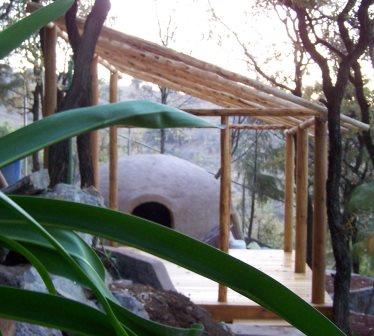
Temazcal Cerro Verde
Photo credit: Carmen Magallon

What is a temazcal?


Jose Alcina, a scholar at Mexico’s Universidad Nacional Autonoma de Mexico (UNAM),  describes a temazcal as a “mesoamerican steam bath”. In essence, it is an integral part of traditional medicinal practices. In Mexico and Guatemala the nahuatl word temazcal or temazcalli refers to the “house of steam” and is characterized by rituals,  steam, aromatic plants, herbs and herbal remedies. It has many names besides temazcal, similarly, the building can vary depending on local customs and tradition. “A temazcal is a construction [that can be] made from different materials, traditionally...clay [or] a kind of adobe, built in a round iglu shape.” In Vincenza Lillo Macina’s seminal work on the Mexican temazcal, the author interviews people in different parts of Mexico who use the temazcal. The temazcal can be rectangular, dome-like or even underground. Nonetheless, Lillo Macina explains “the temazcal is a representation of the Earth’s interior, it is a cave.”


Carmen explains that the temazcal is a pre-hispanic practice that has different goals: it is space to facilitate physical healing for respiratory, circulatory and osteo problems, as well as detoxification. But the temazcal also has a ceremonial component. In Magallon’s words “it can be used as a space for offering and giving thanks to nature, to mark certain dates, for example planting time, the rainy season, harvest, or rituals to honor the patron saint of a town. The use of the temazcal also has a social aspect to it. It has been used to resolve conflicts between peoples; when pueblos, neighbors would have problems, the elders would enter the temazcal to reach agreements.”

The Modern Day Temazcal: Reclaiming the Past

The temazcal has traditionally covered three main aspects of human needs: medicinal, ceremonial and social (as a mediation space). Today the temazcal is being reclaimed by traditional and alternative medical practitioners.  Just as Ayurveda and yoga have become “the go to” practices for many of those in the West seeking traditional, holistic remedies to ailments,  the temazcal in Mexico is an essential element in traditional medical practice that is being used once again as a way for people to find emotional and physical well being.
The Mayas used temazcales and as Magallon points out in our interview, it is common to find temazcales in tourist centers [in places like the Yucatan peninsula.] And you can even see the ruins of a temazcal in Chichén-Itzá. On May 4th, though, the temazcal is not a far away archeological ruin that I would one day love to visit, but a reality that hits me like a brick in the face. When we first come upon Juata Xunhapiti temazcal, my husband Alex jokes “it is a hobbit house”.  We were soon to find out that this temazcal was nothing like the hedonistic hobbit hole since I am sure that Tolkien did not envision his Hobbits panting and sweating to no avail.
The day began with Oki Do Yoga with Reiki Master Veronica Onofri. After about an hour of stretching and aligning ourselves, we changed for the temazcal.  Carmen offered Alex and I sheets: you can tie them around yourselves like Roman togas she explained. I chose to go for all or nothing; I wore my birthday suit and the sheet. Alex wore his boxer briefs and shorts.
Oki-do Yoga. Photo credit: V. Onofri
We walked down the steps towards the temazcal. It was lovely day with white puffy clouds scattered in a clear blue sky. As we descended, birds chirped and flitted from tree to tree. There was a river rock ying-yang sculpture in the side of the hill to our left. Balance. I breathed deep and set an intention for the temazcal: I want this temazcal to help me establish balance in my life.  We approach a wooden, raised deck that serves as a kind of vestibule area. Carmen is there with green enameled chalice. She is beginning the ritual. This takes me back to my Catholic school days. The thick smell of copal, the solemnity of approaching Carmen one by one, the narthex-like wooden deck leading to the temazcal; it’s as if we are going to take communion. I’m not consciously aware of these parallels until later.  
Cleansing with copal
Photo credit:C.Magallon
We each individually ask permission to enter the vestibule area. Here Carmen observes the ritual of cleansing us with copal, a type of incense that has been used in Mesoamerica for thousands of years. After the cleansing, Carmen explains how we must enter the the igloo shaped temazcal.  We approach the temazcal and one by one, we stand before the door and ask Teteoinna, who I later learn is the mother of the gods, permission to enter. We must also state why we are entering; Carmen asks us to “state your intentions.” And I must pause.