Showing posts with label food. Show all posts

Wednesday, September 24, 2014

Hang from a Cliff in Atécuaro

Atecuaro
Rappelling in Atecuaro
Michoacan, the soul of Mexico. Diverse, beautiful, breathtaking. This central Mexican state is full of hidden gems.  One such place is Atécuaro, Michoacan.  About thirty minutes outside of the colonial capital, Morelia, a visit to Atécuaro is a great day trip.  You’ll find a small town that holds a large festival at the beginning of August for its patron saint The Divine Savior, as well La Peña de Atécuaro, a cliff that overlooks the town and the valley. To get to La Peña, you must climb and hike up a steep path through an old growth forest for about an hour.  Anchors in the cliff face are used for rappelling by eco-tourism groups and aficionados.


Atecuaro
Atecuaro's countryside
Atecuaro, Michoacan
Trout farm in Atecuaro
Atécuaro is also peppered with small, artisanal mezcal factories, frog and trout farms.  Visitors can sip on local batches of the agave beverage while frog legs or trout is prepared fresh. La Casa de La Trucha is one of the local trout farms with an on-site restaurant.  Owner and operator, Felipe Arreola explains to the sound of flowing, gurgling water “our trout comes from another farm in Villa Madero. We raise it here in natural ponds, where we sell it once they are about six months old. The secret to healthy trout is that there is clean, flowing water.”  With all the water, greenery and peacefulness, it is virtually impossible not to feel relaxed at La Casa de la Trucha (consuming mezcal will of course also help).
Religious procession in Atecuaro

To visit Atécuaro, you can drive, take a bus, taxi or hire an eco-tourist guide.  For more information on visiting Atécuaro, visit Morelia’s municipal tourism website at http://venamorelia.com.mx/atecuaro/


Saturday, May 31, 2014

Cristina Potters is Mexico Cooks!

For the first time in 2010 Morelia en Boca started showcasing Mexico’s gastronomic culture in Michoacán’s colonial capital.  Once a year traditional cooking methods, along with new trends in the culinary world are brought together in what has become one of the most significant gastronomic events in the country. Cristina Potters is among those to have been present since the beginning. Her close relationship with several of the event organizers gives Potters, whose website Mexico Cooks is praised by Lonely Planet, Travel Age West, and Mexico Premiere, an intimate view of this year’s event.  She confesses she couldn’t miss this year because “of the homage being paid to my good friend (restaurateur of Mexico City’s El Bajio) Carmen “Titita” Ramirez. I am also looking forward to learning about new products from Michoacán, seeing friends and exploring more about cuisines of Mexico and Michoacán from chefs and other producers.” After more than thirty years living in and traveling through Mexico, you’d think that Potters would have found her full, but the gray-haired, blue-eyed foodie is passionate about talking and partaking in gastronomic culture.


Photo Source: Taste of Tequila
Cristina’s first encounter with Mexican cooking was in the convent where she was living when she first arrived in Mexico. Volunteering in the overcrowded Tijuana jail, handing out food to the inmates, it was Mexico in the 80s. “I was studying a postgraduate degree in psychology and theology in the Northwest of the United States, volunteering with a group of people who were working with mentally ill addicts who were homeless. The Bishop of Tijuana got in touch with us. One of the other volunteers, a nun, had a close relationship with Mother Theresa and the Bishop had the hopes that Mother Theresa’s order could help with a very similar situation in Tijuana.” 

As it turned out, Cristina and some of the other volunteers ended up in Tijuana later that year.  That was Cristina’s very first contact with Mexico and Spanish. “I felt like a fish that had been caught and then thrown back into the water. It was bizarre. I loved it!” Her love for Mexico was marked by a disciplined dedication to learning the language. “I would wake up an hour earlier than everyone else and study Spanish. I had an old grammar book that I would use and a Spanish dictionary that I would read. I would memorize five new words a day and make a point of using them in conversation.” Her devotion to learning came turned out to be one of her best investments. She remained in Mexico and even became a Mexican citizen about a decade ago.

Food has been the common thread throughout Cristina’s life in her adopted land. “The first person I came close to in Tijuana was a man who had been in jail for four months.” The inmate, Sergio, was a coyote. “I was handing out food to the prisoners when this hand came out and grabbed my arm. ´Sister, do you speak English? Can you help me?´” After helping Sergio get back in touch with his family in California, Cristina received a Christmas card for years. “It was moving to be able to make an impact on a person’s life like that.” Two and half years later, Cristina’s culinary journey through Mexico continued with a trip to the heart of the country.  Traveling from Tijuana to Michoacán with a nun friend, Cristina found herself 10,000 feet above sea level in a very humble home in rural Tancitaro, Michoacán.  Her month long trip sparked in her a fervor for Michoacán and its food.  “We would eat fresh milk that we’d buy straight from the farmer who’d measure out the milk directly into the pot.  We’d have a piece of pan dulce for breakfast, maybe a piece of fruit. The tortillas were made by hand every day.”

Back in the convent in Tijuana, Cristina learned all she could about cooking Mexican food.  “I didn’t know anything about Mexican food. I knew about cooking, but I didn’t know the first things about how to make a green sauce.”

Cristina affirms that her two main passions in life are food and politics and though she insists the former is “neutral” while the latter is left leaning, her thoughts on GMOs seem to go the same way as her politics. “GMOs mess up the regional cuisines.  Those Monsanto crops, the corn, can cross-pollenate with the native criollo corn. The problem is that the GMO corn is infertile. The seeds are saved from one year to the next, and if the seeds are not fertile, the criollo corn will die off.  Plus, you can’t make a Oaxacan dish with corn from Michoacán. These corns are specific to their region. Those three color tortillas are not gonna happen if the criollo corn disappears!” Her passion for food and politics merge, and Cristina Potters´s love for Mexico is as clear as mezcal joven. Her love for learning translates easily into a love for education and sharing knowledge.  She asks me if I know how to pick out Chinese chile de arbol.  “Chinese chile de arbol?” I am incredulous.  She nods and explains. “If there is no stem, or seeds and it is flat, you can be sure those chiles are Chinese.  They pick off the stems, so there is no excess weight and the same with the seeds. They are flat because they are packed tight.  These chiles are flavorless and bland.” And what about jamaica flowers, she asks me. “The jamaica flower is also being imported from other countries like The Sudan.  The jamaica flower that is dark purple is usually Mexican but ask your marchante if it is nacional.”  Buy local and national food. Now those are political ideals I can get behind and, happily put in my mouth.


Cristina Potters lives in Mexico City with her wife, cellist Judith McKnight. She writes regularly for her blog, Mexico Cooks!

Wednesday, May 28, 2014

American Food and Old Mexico

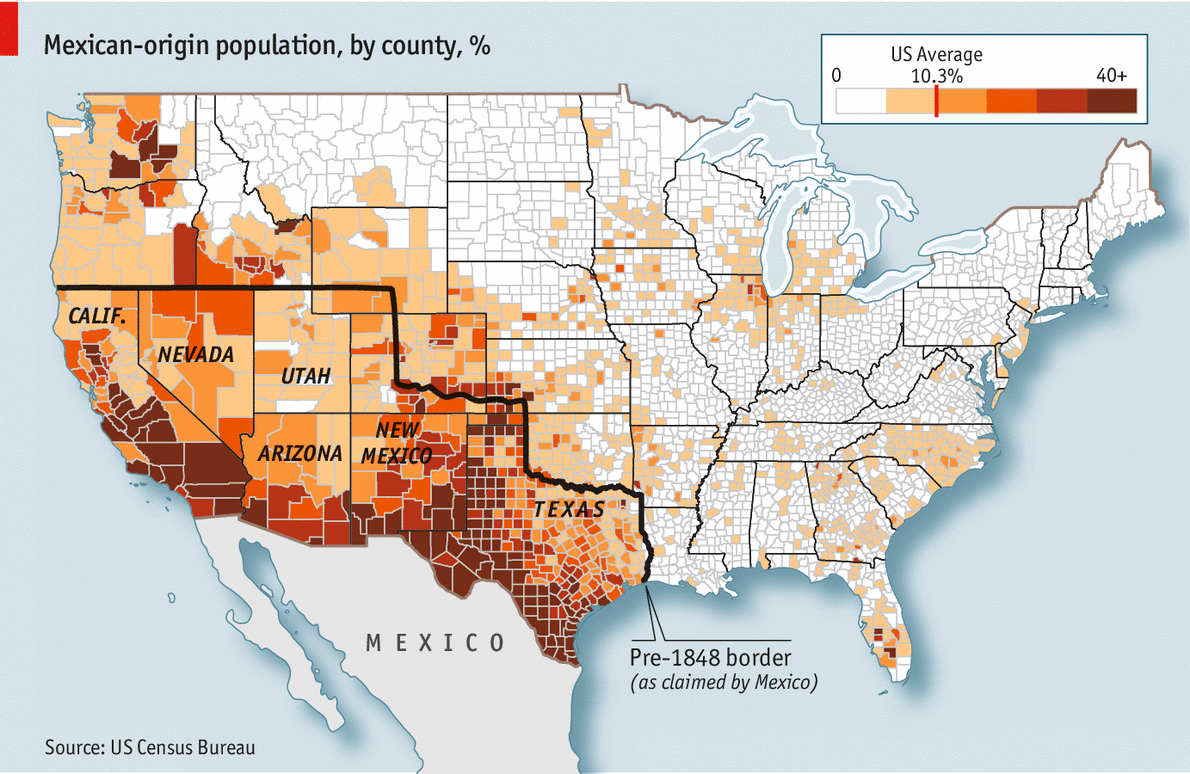
With yet another Memorial Day weekend has come and gone, I´d like to pause a moment and reflect upon the definition of American food. American food  is as varied as it is hard to define.  From beignets to burritos, barbecue to clam chowder, American food is nothing more and nothing less then a hodge podge of flavors, ingredients and culinary traditions from around the world.  

Keeping that in mind, take a look at this map showing the pre-1848 war US-Mexican border.  Then appreciate how much of America is really not that "American" after all.  After the war, basically from one day to the next, a large portion of Mexico became a part of the United States. Which means the food that people ate did the same, it stayed in the same communities but with a different name. The border might have moved but the people didn't. So the next time someone offers you some "good, old fashioned American" food, ask them which kind of tacos they have. 

Note: My apologies to those who caught my mispelling of beignets, just thinking about them makes me lose focus....

http://www.economist.com/news/united-states/21595434-old-mexico-lives


Thursday, January 9, 2014

Aquiles 744: Asian Cuisine in Downtown Morelia

The next best thing to traveling is having the opportunity to try food from a particular region or country.  Many local expats complain that it is almost impossible to find good Asian food in Morelia.  Let alone fresh and healthy Asian food. Yet when Rodrigo Vazquez opened Aquiles 744 he set out to do just this: fill Morelia’s quality Asian cuisine shortage.

Occupying Hotel Portico’s street-level corner space, just a walking distance from Morelia's iconic Jardin Villalongin,
Photo credit:http://morelianas.com/morelia/lugares/jardin-de-villalongin/
the restaurant is small (seven tables and a bar). But what it lacks in space, the owner and chef make up for it in quality and service.  Friendly and efficient wait staff explain each dish while offering choices to those who are unfamiliar with the dishes.  
 
Photo credit: Aquiles 744

The menu features food from different Asian countries like pancit from The Phillipines, bulgogi from Korea, nasi lemak from Malaysia, and pad thai from Thailand. Vazquez offers a variety and selection of Asian dishes and he insists on staying faithfull to the original.  

For those who want something different that features freshness and flavor, visit Aquiles 744. Check out their Facebook page for more information on hours, menus and specials. 

Sunday, September 1, 2013

La Romeria-The Yucatan but in Morelia

          By Alma Maria Rinasz
Chef Freddy Martinez and La Güare. 
Relocating to another country different from the one you were born is a real adventure but there are times when you might not want so much adventure and chose to stick close to home. And just because you live in Mexico doesn’t always mean you get a chance to travel around the country. I’ve found that one of the best ways to “travel” on a budget is to go to specialized restaurants.  La Romeria (Facebook page), is a small restaurant featuring Yucatan cuisine. Chef Freddy Martinez began La Romeria in Santa Maria de Guido (My Mexican Kitchen review) but recently moved the restaurant downtown to the picturesque but often forgotten Jardin Artilleros (map). 
Photo Source: http://www.panoramio.com/user/3735320?with_photo_id=44060378


Comfortable, lightweight chairs and square tables for four are clustered together on the cobblestoned street that has been closed off from traffic.  The menu is simple but seems to give a good basis in Yucatan food.  Sopa de lima, cochinta pibil, frijol con puerco, pan de camaron are featured on the menu. When we ask about my dining companion's sopa de lima, Chef Martinez explained “this isn’t a traditional sopa de lima, it has a base of turkey broth and it’s made with a tomato reduction”.  It is one of most soothing, soul foods I have tried. The next time I have a cold or another hurricane blows through Michoacan (Tormenta Tropical Fernand) I am getting this soup. For dessert, I shared a slice of chocolate heaven, with my mother who joined me at La Romeria. Otherwise known as Pastel Limatour, this edible piece of paradise is from the delectable, local chocolatier Gerardo Torres's pastery shop, De la Calle Real.

Limatour from De la Calle Real Photo:A.M. Rinasz
Chef Martinez doesn’t limit his offerings to just Yucateca food. I ordered chile en nogada, a typical dish from Puebla. A roasted poblano chile, sweated out and seeds removed, is stuffed with a mixture of ground beef, raisins, chopped nuts and seasoning. It’s the smothered in a rich, thick cream that has been mixed with walnuts and topped off with ruby red pomegranate seeds.  Whether in Michoacan, Yucatan or New York, a chile en nogada is hands down one my favorite Mexican dishes. ¡Buen provecho!
Chile en nogada  Photo: A.M.Rinasz


La Romeria is located in Morelia, Michoacan on Bartolome de las Casas #565, Centro Historico (443) 233-7000 (right in front of Jardin Artilleros).

Monday, April 22, 2013

The Beer Fest and the The Lost Boy: A Life Lesson


Local breweries showing their finest

This past weekend the second Festival Gastro Cervercero, set up camp in the Orchidarium annex. We spent several hours there; Chris Sanchez’s Blues Band played, there was Pirekua group as well and a jazz duo. There was a small organic/local farm market where several producers, like Las Canoas Altas, Triskel and Rancho Los Nogales offered their products.


Chris Sanchez Band

And with this break from daily routine, the beer fest was the backdrop for one of the things many parents dread; a lost child. We had arrived hours earlier and set up base camp at Contentedor de Arte’s (CAC) tent where local artists were hard at work painting petates (woven mats) with beer inspired artwork. Since my children are artistically inclined, they joined in the painting and after several hours of hard work, we took a break for some food. 

Painting beer fest artwork


Base Camp: Contendor de Arte's mobile workshop

We were offered free food for being part of the exhibitors and as I went to show my bracelet and my four year old son appeared saying “I want a torta too!” Already carrying a baby, I told him to follow me back to the tent since the torta vendor wasn’t willing to give us any food. Putting the baby back in his stroller, shaded from the incessant sun, I started walking back to base camp, when I remembered I needed to give a friend her cellphone (I had been carrying it). It was seconds after I gave my friend her phone when I saw  my four year old was gone. 

Did he follow me? Did someone come and grab him while I was distracted talking to my friend? I turned to look for him at the food tent; he wasn't there or back at base camp. I went straight to woman with the mic: the festival MC and asked her to call out his name. I was sure he would pop out from behind something (he likes to hide sometimes). He didn't show. The lead singer in the Pirekua band announced his name, over and over. As they called his name over the sound system, I started walking through the empty space between the crowd and the stage; people were staring at me. 


The Pirekua band began up again. Panic rose in my throat and with the Pirekua group’s fiddle as the soundtrack of my own personal drama, I started running down the central aisle of the beer fest, pushing a stroller and  screaming my child’s name. 
It was absolutely terrifying. Several moments of the screaming and onlookers asking me what he looked like, my mind had him gone from me; he was the lost child. A friend appeared, “calm down calm down” she said, “he’s here.” My eyes scanned wildly, “where!?” I yelled. And there he was, index finger in mouth, his legs crossed, holding on to one of the artist’s hands, looking guilty and scared and like the most beautiful thing I could have ever seen in my life, my child, my lost boy was found.


After hugs and kisses and self-recrimination, I realized we were surrounded by people offering us food, drink, consolation: it’s ok, he’s here, nothing happened, it’s ok. Afterwards, people were so understanding and concerned that it was a little hard for me to process: I can be so harsh and judgmental with myself and others that this was a real life lesson in being alert and living in the now.


The found boy and artist at work

PS- Morelia is a colonial city. It is also a bustling, modern day hub of comings and goings, drama and stress; a cacophony of garbage bells, music blaring from trucks selling natural gas cylinders or the traveling green grocer or the merchant that buys and sells old metal (fierro viejo). A midst the chaos of everyday life, there are moments that show me to appreciate that life is more than a harsh mixing of sounds; it can change in a second and I can only ever live it now.


Tuesday, November 20, 2012

Tata Mezcalería


After attending Morelia's Miguel Bernal Jimenez Music Festival and Contenedor de Arte's second annual exhibition entitled Transcripciones Musicalograficas, at Palacio Clavijero, the public and many of the artists converged on Tata Mezcaleria.  Reminiscinet of Prohibition Era speakeasies, patrons ring a doorbell on the limestone door and are ushered in by smiling faces.

A welcoming atmosphere is created through a fun mixture of Mexican modern crafts and art; handmade, miniature toy furniture line a section of a shelf behind the bar and the agave-inspired painting by Rodrigo Treviño hangs in the entryway, as if to say "bienvendo, try some mezcal and here's to your health ". The shelves of the bar are lined with gleaming, crystal clear mezcal bottles, some with monochromatic labels, while others catch the eye and make you want to take a closer look. Mezcal isn't the only thing on the menu; sopes, enchiladas, taquitos, mole, local meats like rabbit and lamb, as well as salmon and chicken are incorporated into Tata Mezcaleria's take on Mexican nouvelle cuisine, or should I say, la nueva cocina mexicana.  Locally brewed La Bru and Mytika beers also are on the menu.

Located on Bartolome de las Casas number 511, several blocks from El Barrio de los Negros, Tata Mezcaleria is definitely worth checking out for anyone interested in artisanal foods, drinks, and a relaxed, colorful setting.

For more information, visit www.tatamezcaleria.com.mx


Friday, February 4, 2011

Review of Il Belcanto

Il Belcanto


A couple of weeks ago I ate at a new Italian trattoria here in town. Il Belcanto, true to it’s name, has a guitar playing crooner strumming songs in Spanish and Italian.


Guitar playing at Il Belcanto
Located on Rey Ticateme #464 in Morelia, the atmosphere is very urban. How more urban can you get by having dinner in a gargage, sitting on plastic chairs and eating at a plastic table?

Street front of Il Belcanto 

Street sign that reads "pasta and salads, Tuesday-Sunday 1-6pm, Sundays live music. Cash only, reservations 443-200-4895"

Joined by my mother, we ordered spaghetti carbonara and spaghetti al pesto with shrimp (with four, yes four, shrimp). The pasta was, a las, far from al dente but the sauce’s seasoning was decent. The prices were not unreasonable at all, $70.00 pesos MXN per pasta dish that included a salad with unlimited bread (sliced bolillo) plus $35.00 MXN per glass for overly sweet sangria. The salad had  a house dressing that was a bit watered down. Over all I would say that Il Belcanto offers Italian food at cocina economica prices and that is pretty much what you get, fresh food that can be a little over cooked with quick, friendly service.

Friday, November 28, 2008

Bugs...YUM!!!

Today I did something new. I ate a scorpion. Correct that, scorpions. Yes you read right, I ate a carnivorous arthropod that had been fried in oil, seasoned with salt and placed a top a helping of pico de gallo( diced tomatos, habnero chilli pepers and onions) on a corn tortilla chip. Right before that we tried chocholate covered scorpions. You may ask: what do they taste like? Well the chocolate covered scorpion tasted, like, well chocolate! The scorpion I wolfed down on the corn torillia chip, that tasted like the pico de gallo with lemon of course. No self respecting Mexican eating a scorpion would leave out the lemon! The University Michoacana San Nicolas de Hidalgo in asociation with the municipal government held a "bug tasting extravaganza" today at the historic Alfredo Zalce Museum here in Morelia, Michoacan. Here are some pictures to prove my gastronomical adventure. ¡Provecho!


The scorpion on the tortilla chip
The scorpion in my mouth

Scorpions in gelatin
Crickets in rice pudding