Showing posts with label Mexican artisans. Show all posts

Sunday, December 29, 2013

On Hiatus


Christmas celebrations in Mexico City
Photo Credit
http://vivetupropiaventura.com/2010/12/07/la-magia-de-la-navidad-llegara-de-nuevo-a-ciudad-de-mexico/

Christmas is a wonderful time in Mexico and is one of the longest holiday seasons known to humanity! It starts the first week in December and goes until January 6th when children all over the country wake up to presents from the Three Kings. 


The Three Kings leave presents under chidlren's shoes
Photo credit: http://www.unionjalisco.mx


For now, dear readers, I am on Christmas break. I will be back soon! Until then, take a look at Canal 22's report on the 2013 traditional Mexican nativity scenes at the Museum of Culture and Popular Art (video produced by Canal 22).


And like we say in Mexico:
¡Felices fiestas! (Happy holidays)

Thursday, September 19, 2013

Victoria Ryan and Casa Encantada: The Wild Child Comes Home

by Alma Maria Rinasz


Victoria Ryan and Paloma, Photo Credit: Todd McIntosh
“I was a wild child,” Victoria Ryan tells me as we sit in La Compañia, a restaurant in Portal Oriente de Matamoros on a stormy Patzcuaro August afternoon. I laugh. “No really, I was certified by the State of California as incorrigible.”  Victoria Ryan hotelier, painter, sculptor, self-declared hippie and naturalized Mexican, uses a cognate to describe herself. Using a word that means the same thing in two languages, provides some foreshadowing on this, our first meeting. The owner and operator of Hotel Casa Encantada, Ryan has named her hotel using a word that has two meanings in Spanish: enchanted and haunted.  She later explains this duality turned out to be a lot more significant than wordplay. 

Born in Australia and raised on Three Rivers Ranch in New Mexico, she moved with her mother to California after her parents divorced. Later, she lived in New York City where she went to the Brooklyn Museum Art School and in 1992, began her love affair with the picturesque Purepechan city of Patzcuaro. Ryan says that Patzcuaro is much like Santa Fe in the 1930s and 40s. “Patzcuaro is alive and vibrant [and similar to] Santa Fe, a place where people felt they could get away from commercialism and live a purer life.” Writers and artists flocked to Santa Fe searching for this purity and Patzcuaro has offered this same environment to Ryan.  The arts are closely linked to her love affair with Patzcuaro.  A painter and sculptor, her hotel is full of her and other artists artwork  Ryan is in good company as an artist and sculptor. Other artists have come to the area seeking that unadulterated atmosphere that is a part of Patzcuaro’s personality.  Most notably, Judith Deim, who arrived in Central Mexico as a part of a painting expedition funded by John Steinbeck.  An avid art collector, Ryan is proud of the pieces she has from Judith Deim and Tom Hamil.  Both influenced Ryan as a collector and artist.  Ryan and Deim became friends, and she describes Deim as a true gypsy and a “horse trader, wheeler-dealer artist”.  On one occasion, Deim’s had agreed to sell Ryan a painting and then asked her to leave it to be “cleaned up”.  Ryan never ended up with that particular picture as it turned out Deim had promised it to her daughter.  Ryan laughs as she tells the story. “I hung up on her when she told me the painting was for her daughter.”  Later, the two made amends and Ryan recalls Deim with affection and respect.


Front view of Ex-Colegio, Patzcuaro.
Source: www.lajornadamichoacan.com.mx


Patzcuaro Museum of Artes y Oficios.
Source: www.patzcuaropueblomagico.blogspot.mx
Photo Ariel da Silva
 www.hotelcasaencantada.com
Patzcuaro, Portal Matamoros
Photo credit:www.visitmichoacan.com.mx

Patzcucaro vibrancy comes out in lights for the September Independence Holidays

Destiny Calls: Casa Encantada

Casa Encantada, built in 1784, is a colonial mansion that Ryan has painstakingly remodeled into a comfortable B&B boasting some of the only heated rooms in Patzcuaro.  At 7020 feet, this quaint town in the heart of Mexico can get very chilly. With gas fireplaces in every room, goose down comforters, heated king sized mattresses and fluffy flannel sheets, La Casa Encantada delivers on its name: it will wrap you up in warmth and keep you enchanted.


Hotel Casa Encantada, Main Patio.
But Ryan’s home was always so encantada.  There was a time when her home had some unwanted guests.  Ryan had initially intended her Patzcuaro home to be an artist’s retreat.  As she set about remodeling and redecorating, she found herself painting and repainting a particular room.  After complaining to a friend about not getting the color right, her friend told her she should consult a curandera.  “I just couldn’t get the color I wanted. And that was when my friend suggested I seek the help of a curandera.”  A traditional medicine practitioner or healer, curanderas are often referred to as brujas; witches, psychics or mediums.  Their services are retained so they can, through different rituals, clean out spaces (hacer limpias)  and remove bad spirits or energies from people. In the case of Victoria Ryan’s home, the curandera found several spirits.  La Casa Encantada turned out to be somewhat haunted.  “She said there was a starving man, a lonely child, a cook….” Ryan smiles as she recalls the limpia.  All these spirits were then set free with by the curandera’s rituals.  Then, after liberating the home of these spirits, the curandera told Ryan something else about her house.  She told her that her house, La Casa Encantada, was her destiny.  The wild child, it seems, has finally come home.

Victoria Ryan paints

A Prologue to the Prophecy


It is a chilly Patzcuaro evening and Ryan has invited me to visit her in her on-premise apartment.  Earlier that day, as I walk towards Hotel Casa Encantada, the aromas of linseed oil, damp earth and burning ocote greet me.  This evening, as I sit opposite Victoria Ryan, on an over-stuffed sofa, those same smells greet me once again.  Patzcuaro has a particular scent and feel to it and Victoria has not only become an expert at Patzcuaro life, she has become a Patzcuarense herself.  Ryan’s father, Thomas F . Ryan III, was born in Chihuahua. Thanks to the constitutional reform in 1998, children of Mexicans born outside of the country were granted the right to citizenship.  And fortunately for her, being the child of a natural born Mexican gave her the possibility to make Patzcuaro her permanent home.  The secluded nature of Patzcuaro had a real pull on Ryan.  When she first arrived to Patzcuaro she didn’t have a phone “you’d be on the waiting list for years and when I finally got a phone I wasn’t sure if I even wanted it. I ended up disconnecting it and locking it in a closet. That way if I wanted to use it, it would be when I wanted to communicate with someone, not the other way around.”  

Victoria tells me her story with genuine emotion.  Sipping red wine, she holds Paloma in her lap.  Paloma, Ryan’s faithful companion, is a mild-mannered long haired Chihuahua.  Paloma’s personality reflects that of her owner: she is serene and friendly.  Ryan is a mature woman who has all the confidence and tranquility that comes with age.  However, she insists she hasn’t always been so composed. At sixty-seven years old, Ryan has had her fair share of up and downs.  In her wild child days, she would often run away from home.  At sixteen, she gave birth to her first daughter and gave her up for adoption.  As a young woman in New York City she lived a “bohemian lifestyle”, studying art and marrying a writer.  After having her second child in 1972, Victoria adopted her nephew, Thomas Ryan V, after his mother died.  Then, after her divorce, she moved to California,  where she frequently visited Esalen and lived “the hippy life in a tepee.”  She tells me that she hasn’t always been clear on what direction her life was taking yet “my entire life I have had the feeling that I was being led.”  Maybe this feeling of being led is a little of that enchanted-ness that she has been able to recreate in her B& B combined with her own family history. 
Hotel Casa Encantada, second floor view


The Ryan family history reads like something between Taylor Caldwell’s A Prologue to Love and F.Scott Fitzgerald’s TheGreat Gatsby.(Ryan's greatgrandfather was Thomas F. Ryan,)   Drama, excesses, twists and turns, Ryan is quite open about her past and the Ryan family.  “My father was very wealthy and he was an alcoholic. He would go on these binges and find himself married to someone new. He was married, something like, eight times.”  Undoubtedly those experiences left their mark on Ryan.  Raised a Catholic, she now calls one of the world’s most Catholic countries home. Perhaps this is one of the reasons Ryan felt so comfortable in Patzcuaro.  Her Catholic upbringing was a part of Ryan family tradition.  Her great grandmother, Ida Barry Ryan, was a Countess of the Catholic Church, being the only person, a part from the dowager Queen of Spain, Maria Cristina, to have a private railcar chapel.
Casa Encantada Kitchen.
Patamban Pottery complete with original stove.

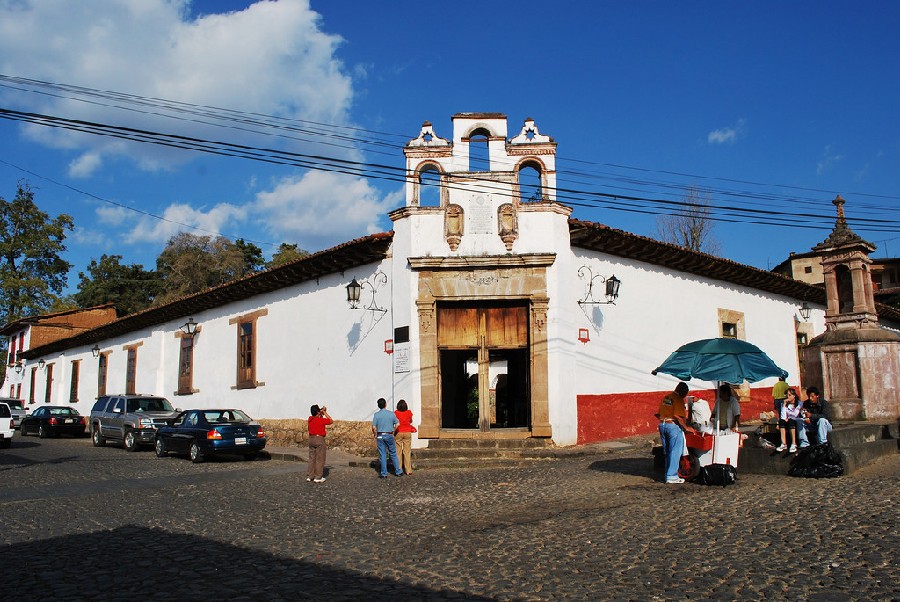
Her hotel, as it turns out, is suitably named since the town in which it is located is without a doubt enchanting.  Its colonial architecture, shuttered windows, indoor patios, authentic Mexican kitchen complete with Patamban pottery, set the stage for a real Mexican experience.  Ryan’s home feels, smells and is totally Mexican.  Patzcuaro has a particular scent and feel to it and Ryan enjoys telling me all about it.  “There are months’ worth of things to do and see in Patzcuaro”  she raves.  “The ex-colegio is doing a better job than ever at marketing and using all the rooms to showcase art, something they had never done before.” She continues to explain that in the Patzcuaro area, “there is art and artisans, history and archeology and people would be surprised to know how lush Patzcuaro is.”  Yet, she warns that “to live in Patzcuaro you need to be able to entertain yourself.  If someone needs external stimulation you’re not going to find it in Patzcuaro.” 

Photo Ariel Da Silva
www.hotelcasaencantada.com
Hotel Casa Encantada, is one of the top 25 hotels for service, number one for hotels in Patzcuaro and Traveler’s Choice for 2013 on Trip Advisor.com.  It is a true haven and as Ryan puts it, one of the most beautiful colonial towns in Mexico.  It is a destination for anyone who wants to get to know what Mexico is really like.  It is in the heart of the country and Patzcuaro, a town that has been thriving for centuries, is the ideal location to be enchanted.  For more information, please visit www.hotelcasaencantada.com 

Monday, September 9, 2013

One Saturday Morning: Museo Soumaya, Plaza Carso

            by Alma Maria Rinasz

If you are planning on visiting Mexico City and have a free morning, why not give Museo Soumaya, Plaza Carso a try?

On Saturday, August 24th, after a short ride from the art deco inspired Colonia Condesa, (to read an architect's take on art deco in La Condesa, read Jim Johnston's blog here) I stood for the first time in front of Museo Soumaya, Plaza Carso in the heart of Polanco.  Among the noise, traffic and movement so typical of Mexico City, this windowless, silver building looks out of place.  Shopping centers and office buildings flank the museum, a building that makes me think of an educational toy used to learn about geometry.  Walking up the steep steps, it is hard to look up at the architecture without tipping over and crashing down the stairs.  I pause at the top of the steps and see a revolving door bearing the name of the museum in cursive letters.  It is still early and there aren't many people entering the building. I take one last look around at the skyline; a Saks Fifth Avenue sits next to the museum, followed by a Cinepolis VIP.  This is a museum with some swanky neighbors. 
Museo Soumaya,Plaza Carso, exterior


Walking through the revolving doors there is a coat check area off to the left and a security check directly ahead.  The day is cool and so is the museum.  As I walk through security I see a familiar sculpture.  It looks like TheThinker by Rodin.  It turns out to be one of the more than two dozen castings of the original sculpture.  If I had known that one of its siblings had just sold for more than 15.3million USD I might have snapped a close up but I took this picture instead. 
La Gúare and The Thinker
Visitors to the Soumaya can take all the photographs they want, along as they don’t use flash on their cameras.

I first walk through the ground floor.  There are restrooms, information booths, an empty cafeteria, a Telmex sponsored computer lab and a gift shop. The gift shop is full of merchandise from Sanborns; one of Carlos Slim’s many businesses.   The Carlos Slim Foundation is responsible for both museums, Plaza Loreto in the southern colonia of San Angel and Plaza Loreto, in Polanco.  The gift shop has what you’d expect to see in a gift shop: memorabilia and souvenirs that say Museo Soumaya and some elegant examples of artisanal work; lacquered boxe and ceramic tiles. There are also impressive looking chelophane wrapped books on different periods in art history.

Heading up the ramp towards the upper floors, I look over booklet I picked up at the information booth.  The museum is divided into six rooms or salas.  I begin in Sala 1, Oro y Plata, Marfil y Madera (gold and silver, ivory and wood). 
Ivory sculpture, Museo Soumaya, Plaza Carso
It is not until I am in Sala 3 that I come across Abdul Bornio, dressed in dark beige suit, explaining the how religious art was used by the Spanish to conquer the hearts and minds of the aborigonal people in the Americas.
Guide Abdul Bornio explaining works of art
I stop to listen and realized that this young man is most likely one of the guides mentioned in the booklet: "free guided tours Saturdays and Sundays at 11 am 1:30pm and 5pm" the pamphlet reads. I ask if I can join in the tour and Mr. Bornio welcomes me with a smile.  We continue walking among paintings by old Europe and Novohispano masters.  I am particularly impressed with the painting by Pieter Brueghel, the younger and upon arriving home find his father, The Older, in an art book featuring work from El Prado.  Our guide begins to explain some of the sayings that are still used today.  These are Flemish proverbs. Mexico, being a Spanish colony, inherited these European sayings as a part of colonization. This cultural context is 
Flemish Proverbs by Pieter Brueghel The Younger
 one of the benefits of having a guide and I highly recommend taking one of the guided tours.  Mr. Bornio explains, as we continue on to Sala 2 where the temporary exhibition of Asia in Ivory is housed, that the best way to see the museum is to begin at the top (in Sala 6) and work your way down.  Our tour finishes in Sala 1, (gold and silver, ivory and wood) in front of a silver sculpture by Bvlgari.  Mr. Bornio explains that it was a gift from the Italian jewlery design house to the Slim Foundation.  He points out some of  differences from the actual building and the sculpture.   
Bvlgari silver reproduction of Museo Soumaya, Plaza Carso

I finish my visit to the museum on my own.  However, Mr. Bornio explains that the reason why there are six rooms is because Carlos Slim and his late wife, Soumaya Domit, had six children and each one of these rooms reflects the personality and likes of each one of these children. Sala 6 is the only one with the names Julian y Linda Slim.  Julian Slim,  I later discover is not one of Slim’s children, but his late brother and Linda, Julian’s wife.  This room boasts the only source of natural light from a large skylight.  The pieces of art here are sculptures by Rodin and Dali.

What impresses me the most about this museum is that it has an notable collection of art from all over the world and it is completely open to the public and free of charge to visit.  Mexicans can interact with works of art that perhaps they might not otherwise be able to see in person. There is a lot of criticism about Slim and his fortune here. However, while I was at the Soumaya Museum I couldn't help but feel overwhelmed and in awe of so much diversity in artistic experssion. There is even free internet and the bathrooms are impeccably clean and beautifully designed.  (These bathrooms are just phenomenal: wall to ceiling mirrors, a long marble sink with over a dozen faucets, .most public restrooms are never this nice).  Some of the artwork has small digital stamps next to their information cards that are recognized by Android devices and will give you more information about the art.  This is a great thing to do on a Saturday morning in Mexico City.  You can get coffee or hot chocolate in the waiting area on the ground floor.  After visiting Soumaya Museum, Polanco has a lot to offer as well with restaurants and shopping centers close by. 
Points to remember when visiting Soumaya Museum, Plaza Carso:
  •  Dress accordingly. Bring a sweater, it is chilly!
  • Know where to begin. Start at the top in Sala 6 and work your way down.
  • The more you know, the more you’ll enjoy it. Try and join one of the guided tours, it is worth it.
  •  Get inside information before visiting! Make sure to like the museum on Facebook or follow on Twitter.
  • Avoid stress and meltdowns if you are planning on taking children. As a mom, I recommend ages 10 years old and up. This museum is not suitable for younger children and they will get bored very quickly.  
Museo Soumaya Plaza Carso is located on Blvd. Miguel de Cervantes Saavedra 303 Col. Amplicacion Granada Mexico DF and it is open every day from 10:30am to 6:30pm.

Wednesday, August 21, 2013

Rose Calderone & Casona Rosa: The Heart of Morelia


by Alma Maria Rinasz
It is Thursday, June 27th, at 4pm in the old Purepechan capital of Patzcuaro, Michoacan. People from all over the central Mexican state have come together to the unveiling of Jesus Alejandre’s The Possessors of the Fish (Los Posesedores del Pesacado). The afternoon monsoon-like rains have uncharacteristically stayed away. People mingle among images mounted on six foot square metal frames. These are the images of The Spirit of Michoacan, a series of photographs taken over a six year period by Alejandre. Among the mix of artisans, musicians, museum patrons, writers, guests, government officials, expats and curious onlookers, stands a woman nearly six feet tall. Wearing a traditional Michoacan dress and purple horn rimmed glasses, her smiling face and puckish blue eyes are framed by a shock of short, spikey white hair.  This is Rose Calderone.  Calderone and Alejandre met several months earlier, when Calderone asked to buy a photograph from Alejandre’s Patzcuaro series at one of his shows in Morelia.  “He didn’t have one” Calderone says in her interview in the video  showcasing the project, to which Calderone responded “let’s make one!”


Jesus Alejandre, Rose Calderone & Susan Tucceri with
Lake Patzcuaro fishermen. Photo: Andrea Gudiño Sosa
Divine Accidents
Calderone’s first visit to Mexico came about after two houseguests in her Chicago home invited her to visit Morelia. “I came for ten days for Christmas in 2002. I returned in February 2003 and started to come more and more frequently.” Calderone describes her return trips and eventually setting up a B&B as a divine accident.  “I had rented a place on Aldama Street, a private home with several apartments that shared a common patio.” After some time, Calderone began renting the other apartments. Close friends and family would stay when visiting Morelia. After Noche de Muertos in 2007, Calderone recalls a friend and a Lonely Planet writer visiting her. “Morelia was like a Filini movie, you couldn’t sort out the noise, the people, the drinking. Many of my friends were there are the house and a friend and her family wouldn’t let anyone leave unless they had a beer or a bottle of tequila.” It was then that the Lonely Planet writer asked Calderone if she was interested in having her B&B published in the guidebook. She said no. Up until then, Calderone’s business was that of nannies and sleep training babies, she was not the owner of a B&B;  up until then, she just took in friends and friends of friends.  However, during her stays in Morelia, she had created an authentic space where travelers, both foreign and national, were eager to visit and tell their friends about. When Calderone was finally ready, her B&B was mentioned in Lonely Planet but no address was given.  “People would search me out, one woman slept in her car until she could find us” Calderone laughs. Whatever she was doing, it was working. 
Around the same time that Calderone started frequent visits to Mexico, her father encouraged her to start her own business in Chicago.  Calderone’s says that her father has been one of the most influential people in her life. As a young woman, Calderone Sr. fostered his oldest child’s entrepreneurial spirit. “I was curious about business, [so] he gave me a bookkeeping job in high school. Dad was Sicilian, very old country, quiet, an entrepreneur, a man of integrity and honesty. He was doing what he wanted to do and the freedom and joy that comes with it…”. Calderone smiles as she recalls her father, who according to her, rarely spoke.  When he did speak, she would pay attention.  “He was an early riser. One morning, I was typing a newsletter and he said to me, ‘you sure work hard but you need to work smart’.”  Those words of advice have stuck with Calderone and perhaps are a part of her secret to success.  In 1999, after years of working as a nanny,  Calderone had developed a special talent for sleep training babies.  “I was getting so many requests to do the work and the truth of it is that I was just able to sleep train babies, and again, it was, it was just an accident.”
Thankfully, Calderone Sr.'s quiet nature was not inherited by his daughter: Rose Calderone is powerhouse of energy and charisma.  It seems almost ironic that such a vivacious, gregarious person could help babies learn on to sleep on their own.  And fittingly enough, getting Rose Calderone to sit down is like much like convincing a baby that she is indeed ready to go and stay asleep.  Constantly on the move, Calderone runs La Casona Rosa and her nanny business in Chicago simultaneously.  After almost fifteen years of specializing in sleep-training babies, Rose Calderone has established her successful nanny business. And now she is making a name for herself in the B&B business in Mexico. It is clear that Rose Caledrone is a woman of her own making.  When not in Chicago, or touring the colonial highlands making friends with artisans, she can be found at La Casona premises.  And Calderone is hardly ever still.  Balancing her phone on one shoulder, picking up random bits of rubbish, straightening furniture in the historic17th century building that houses the Casona,  Calderone is an endless supply of smiles, hugs and positive words.  Her joie de vivre is by far her most contagious trait.  And this joy has spilled over into her interactions with local artists and artisans.
A Life With Art
Rose Calderone listens as Jesus Alejandre, background,
introduces his work. Photo: Tonatiuh Torres Bravo

Growing up the oldest of five children, Calderone earliest exposure to arts was from her younger sister Kathy. Kathy played the piano, painted, spoke five languages, in Calderone’s words “a renaissance soul growing up in rural Michigan.” At twenty four and honor student at University of Michigan, Kathy committed suicide.  Calderone was thirty at the time of her sister’s death. “At a certain point I had to make the decision that I was committed to life or I was committed to the alternative… depression or worse.  I had my son and that was really a declaration of life.” In Chicago, Calderone once again came into close contact with the arts.  She was involved in the Around the Coyote Arts Festival and after moving in California, she became intimate friends with musician Taj Mahal and his sister, singer CaroleFredricks.  

In 1970 Calderone met Taj Mahal for the first time. At the time she was dating Mahal’s photographer, friend and road manager. They had met after Taj had left LA for the Berkley Hills. “He couldn’t be put in a box; he was reaching out to what we now call world music. He was pigeon holed by the music industry and I saw his struggle to become an artist, my first real close up view of an artist who was trying to fit in and make a living from his art.” Calderone also became very close to Taj Mahal’s sister, Carole Fredricks. “I met Carole through Taj. Two of my friends had opened the first French restaurant in the Napa Valley. In 1979 I introduced Carole to Gregory Lyons and his partner Phillipe.”

Calderone’s relationship with Taj Mahal has evidently impacted the way she relates to artists. “For the most part you don’t get to see, have an intimate look at how an artist creates. Even if the artist is one of your most intimate friends, you don’t do that…”  Calderone has cultivated her sensitivity to a point where now, she helps promote art in Michoacan. Her recent involvment commissioning photographer Jesus Alejandre is testament to her love for the arts. Her commitment to the project is just the next logical step in her own evolution.  After seeing Jesus Alejandre’s Espiritu de Michoacan show and meeting the artist in person,  the over six foot tall photographs (1.40 by 2.50 meters) impressed Calderone to the point where she commissioned one. The result is by far one of the most representative images of the lake and its personality.
Los Poseedores/Jesus Alejandre


Calderone’s contagious energy has infected other expats as well.  Susan Tucceri, a retired restuarent manager from San Francisco, became a part of the team now surrounding Alejandre’s project after seeing Calderone’s enthusiasm for the photographer’s work.  The mother of painter, Tucceri does not create art herself but “recognizes that [talent] in Jesus.”  “After my son died I came to Morelia and fell in love. Everyone was so gracious, the people where wonderful. I had been living in San Francisco for twenty years and it was a dream to live in Mexico.  [I knew] I’d never find anything better than Morelia. There were too many Americans in San Miguel; Morelia felt authentic.”  After Calderone commissioned Alejandre to do the “ultimate Patzcuaro fishermen photo”, Tucceri accompanied Calderone on the photoshoot. “I adore Jesus, he is just a geniuine young man, how he realtes to people and how people relate to him.”  When asked which of Alejandre’s photograph impressed her the most, Tucceri answers “the pineapple fields image. It knocked my socks off.”
Tierra de las Piñas/Jesus Alejandre 

Good Things to Say About Michoacan
Michoacan has been getting a lot of  coverage in the press in and outside of Mexico over the past few years. In 2008 when a blast ripped through a street full of people celebrating Independence Day, Morelia was shown in the media as a troubled area in Mexico. Since then, Michoacan in the the international media has been called lawless, heavily criticized for the corruption in the government and in a recent LA Times article put it Mexico has a "drug war at our doorstep." The State Department no longer visits the state to provide citizen services and the Defense Department has restricted travel by Marines to the state. With all this violence, bad press and a notorious reputation, it is easy for Mexico and the world at large to write Michoacan off. But like those who stay in war torn cities and towns,  those who carry on their lives and make the best with what they have, Michoacan's history and traditions are as vibrant and alive as ever. The Soul of Mexico still draws in foreign tourists and expats alike.  Those who stay out of choice and necesity do so and in the case of Rose Calderone, showcase the positive qualities that this state has to offer the world.

Here is a virtual tour of Casona Rosa
Posada La Casona Rosa~Enjoy the Magic of Morelia! from Rose Calderone on Vimeo.